
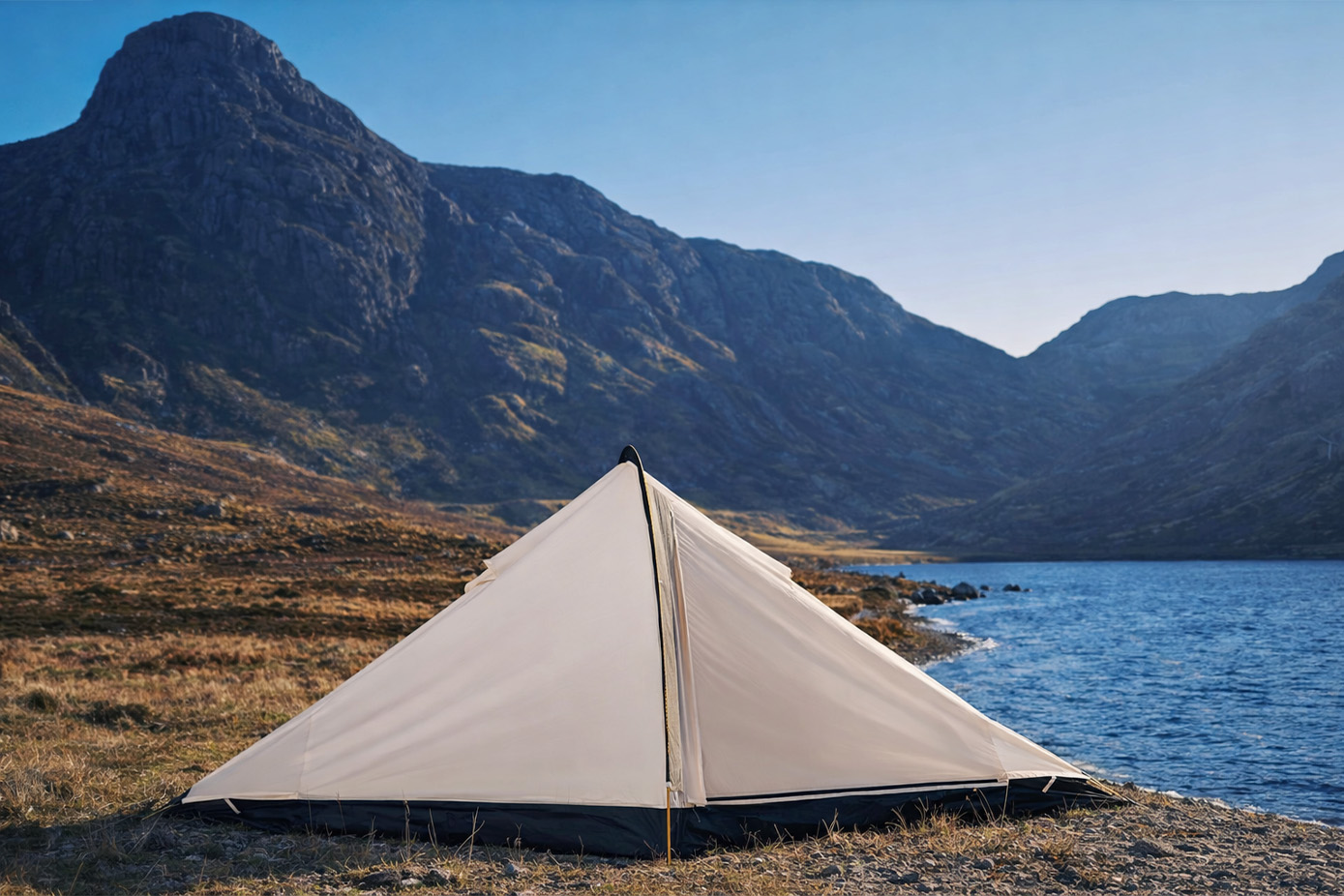
For ultralight backpackers, the pyramid tent has long been the go-to for efficient design. With just a single trekking pole and a few perimeter stakes, these shelters deliver excellent space and weight savings. But that simplicity comes with a catch: they often struggle in strong side winds.
The Wind Anchor takes a different approach. Using only one support pole, it demonstrates wind resistance equivalent to Beaufort Force 12.
In this article, we will break down the underlying logic of the Wind Anchor’s stability, from its core physics to its patented design.

Constraints of Traditional Single-pole Tent
To understand the design value of Wind Anchor, we first need to understand the long-standing structural challenge faced by single-pole tents.
1. The Core Problem: Stress Concentration
The problem with traditional single-pole tents is stress concentration. As wind hits the flysheet, the lateral pressure and uplifting forces are funneled directly into that lone central pole and a few critical anchor points. Once the wind direction shifts, or even just one anchor point loosens, the entire tent's stability rapidly collapses.
2. Why Multi-Pole Tents Are More Stable
In contrast, multi-pole tents, whether tunnel, dome, or complex geodesic designs, are inherently more wind-resistant due to stress distribution.
Their multiple poles create a redundant, inter-supporting network that channels forces through various nodes to the ground. Even if one section is compromised, the overall structure holds its shape.
This leads to the core engineering challenge the Wind Anchor solves: How can a single-pole structure achieve the stability of a multi-pole tent while remaining ultralight? The answer lies in its unique Semi-Conical Geometry.
Semi-Conical Structure: The Foundation of Wind Stability
1. Semi-conical Spatial Design
The core patented innovation of Wind Anchor is its unprecedented semi-conical spatial design.
The flysheet of the Wind Anchor extends outward from the support frame, and the enclosed space gradually narrows from one end to the other, forming a semi-conical space. This "conical apex" is anchored directly to the ground using stakes, serving as a key node in the overall structural load system.
2. Aerodynamics of the Semi-Conical Shape
The shape is not just about good looks; it has a clear physical significance in aerodynamics.
When wind strikes the semi-conical flysheet from any direction, the asymmetrical, curving surface allows airflow to follow the contour of the tent with minimal resistance.
More importantly, this flow pattern physically creates a downward pressure component on the flysheet. In other words, the stronger the wind, the tighter the tent is pressed to the ground instead of being lifted.
This represents a fundamental difference in load logic compared to traditional tents:
(1) Traditional tents: Wind → head-on impact on flysheet → lateral thrust + uplift forces → frame and anchor points subjected to tensile stress → structural instability
(2) Wind Anchor: Wind → guided flow along curved surface → converted into downward pressure → more wind, more stability

3. Balanced Tensioning System
Additionally, Wind Anchor features a tensioning system that connects the support frame at one end and anchors to the ground on the opposite side of the conical apex, providing symmetrical counter-tension for the entire tent. This balanced tension mechanism ensures that the tent maintains a stable structural configuration regardless of the wind direction.
Strategic Dual-Stake Anchoring
When it comes to withstanding high winds, how a tent connects to the ground is just as critical as its frame.
In high-wind environments, the core threat to the stakes is pull-out force — wind energy transfers through the flysheet and frame to the stakes, attempting to yank them out of the soil. This is the most common real-world cause of tent failure, especially on soft ground such as sand, snow, or wet soil.
Wind Anchor addresses this problem with a Strategic Dual-Stake Anchoring System. By using two stakes to enhance soil grip, the system provides stable support under high winds. The dual-stake setup distributes forces in two directions. Even if one stake shifts in soft ground, the other remains engaged, maintaining the tent's fundamental stability.
Wind Anchor vs. Mainstream Tents
|
|
Tunnel |
Dome |
Wind Anchor |
Refuge |
A-frame |
|
Total Weight |
940g |
1800g |
600g |
595(exclude trekking poles) |
2820g |
|
Waterproof Performance |
1200mm |
4000mm |
5000mm |
1500mm |
2000mm |
|
Wind Resistance |
Moderate |
Enhanced |
Superior |
Moderate |
Enhanced |
|
Positioning Stakes |
6 |
6 |
4 |
6 |
6 |
|
Structural Poles |
2 |
2 |
1 |
Nil |
5 |
|
Door Orientation |
One-way |
One-way |
Two-way |
One-way |
One-way |
|
Ventilation Design |
No |
No |
Yes |
No |
No |
|
Flysheet Style |
Sole |
Sole |
Varied |
Sole |
Sole |
|
Setup Method |
Complex |
Complex |
Fast & Easy |
Complex |
Complex |
Who is the Wind Anchor for?
1. The Ultralight Purist
For long-distance trekkers who count every gram. With a trail weight of just 650g (Pro version) and an incredibly compact pack size, Wind Anchor Pro offers a rare combination of weight savings and elite wind resistance that's hard to find in today's market.
2. The Fast & Light Adventurer
No complex pole puzzles here. Wind Anchor pitches in about 60 seconds, making it perfect for those who need to move fast, set up camp at sunset, or minimize exposure in changing conditions.
3. High-Altitude & Alpine Explorers
If your journey takes you to exposed plateaus, coastlines, or ridgelines, this is your sanctuary. With its patented semi-conical design and a structure tested against Beaufort Force 12 winds, it provides the physical strength and mental peace of mind needed in the most high-risk environments.
4. The Versatile Backpacker
The Wind Anchor isn't just for the ground; it can be paired with a standard hammock for suspended camping. This gives you extra flexibility in wet, uneven, or bug-heavy terrain.

Safety Note: At THECATAL, we engineer our gear to withstand up to Beaufort Force 12 to ensure your safety during unexpected, severe storms. However, we do not encourage intentionally seeking out extreme weather to "test the limits." Your safety is always our top priority.
Wrapping Up
Can a single-pole tent truly stand up to high winds? The answer is yes. With its semi-conical structure, Wind Anchor transforms wind from a threat into a source of stability.
Ready to rethink what a single-pole tent can do? Explore Wind Anchor.


Leave a comment
This site is protected by hCaptcha and the hCaptcha Privacy Policy and Terms of Service apply.